
Let me be direct with you: most marketing teams are still building playbooks the same way they did in 2015. Static documents, rigid workflows, quarterly reviews that are already outdated by the time they're approved. The world has moved on. Your playbook hasn't.
AI-powered marketing playbooks aren't a buzzword upgrade to your existing process. They're a fundamentally different operating model — one where your campaigns adapt in real time, your messaging evolves based on actual signals, and your team stops guessing and starts knowing.
Here's how to build one that actually works.
What an AI-Powered Playbook Actually Is (and Isn't)
Let's kill the misconception right away. An AI-powered playbook is not a chatbot that writes your emails. It's not a tool that generates mediocre ad copy at scale. And it's definitely not a dashboard full of vanity metrics dressed up with machine learning labels.
An AI-powered marketing playbook is a living decision framework. It uses real-time data, behavioral signals, and predictive models to determine what action to take, when to take it, and who to take it with — then executes at a speed and precision no human team can match alone.
Think of it like the difference between a GPS system and a paper map. Both can get you to the destination. But only one reroutes when there's traffic.
The Four Layers of an Effective AI Playbook
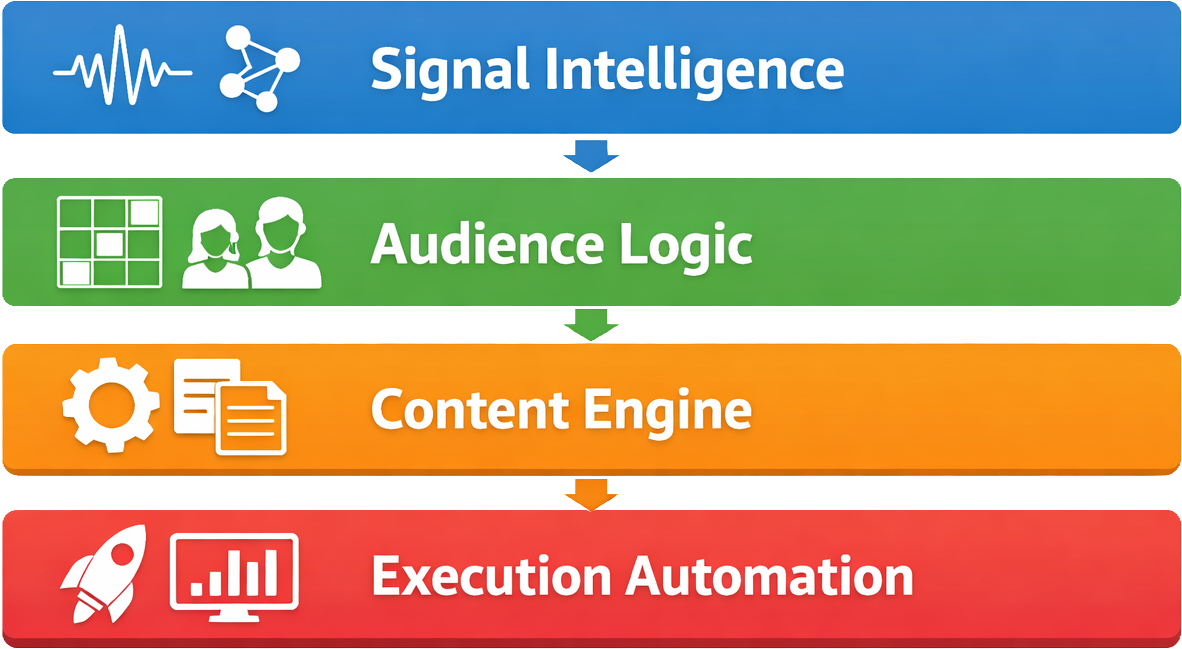
Layer 1: Signal Intelligence
This is where your playbook gets its data diet. You need to be pulling signals from:
- First-party behavioral data — what people are doing on your site, in your product, in your emails
- Intent data — third-party signals showing who's in-market right now
- CRM activity — deal stage changes, engagement scores, last touch points
- Market signals — competitor activity, category search trends, news triggers
Most teams are only using one or two of these. The teams winning in 2026 are synthesizing all four into a unified signal layer that feeds every campaign decision downstream.
Layer 2: Audience Logic
Once you have signals, you need rules that translate signals into audiences. This is where AI earns its keep.
Instead of manually building static lists, your audience logic should be dynamic — automatically segmenting contacts based on behavioral patterns, scoring them against propensity models, and routing them into the right campaign tracks without a human touching a filter.
A good audience logic layer answers: *Who should receive this message right now, and why?*
Layer 3: Content Engine
This is where generative AI fits — but with guardrails. Your content engine should be producing variations, personalizing at scale, and testing messaging permutations faster than any team could manually.
The key is training your AI on *your* voice, *your* positioning, and *your* customer language — not generic internet content. Feed it your best-performing assets, your customer interviews, your win/loss analysis. The output quality will be night-and-day different from what you get with out-of-the-box tools.
Layer 4: Execution Automation
All of this means nothing if it doesn't move. Your execution layer should be triggering sends, launching ads, updating sequences, and routing leads based on the output of the layers above — automatically, in real time, with humans reviewing outcomes rather than initiating every action.
Building Your First AI Playbook: A Practical Starting Point
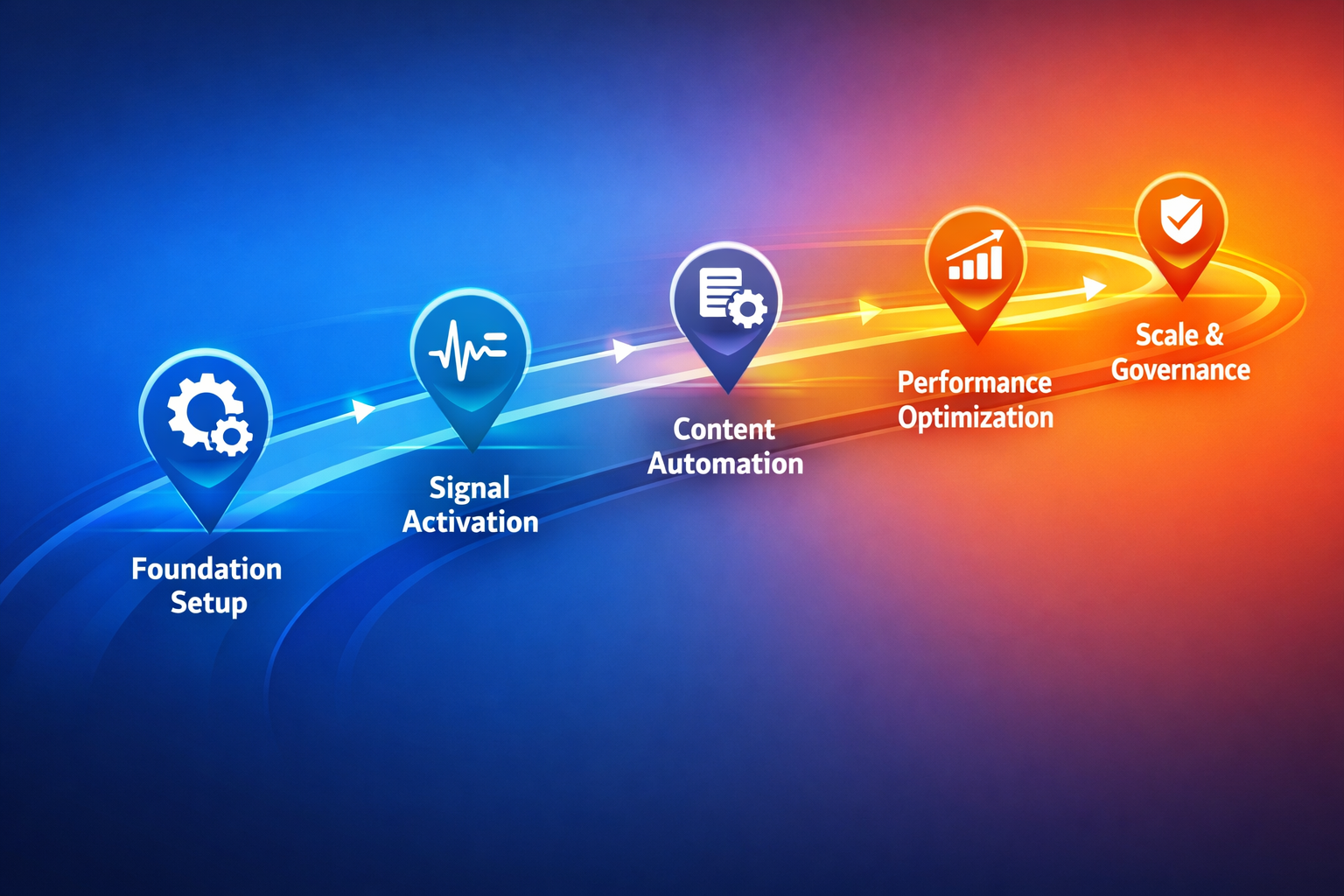

You don't need to boil the ocean on day one. Here's a realistic starting point:
Step 1: Pick one campaign motion to automate first.
Don't try to AI-enable your entire go-to-market at once. Start with your highest-volume, most repetitive campaign — usually outbound sequences or nurture tracks.
Step 2: Audit your signal sources.
What data do you actually have? Where are the gaps? You can't build smart playbooks on dumb data. Spend two weeks just cleaning and connecting your data sources before you touch any AI tools.
Step 3: Define your decision rules.
What should trigger a message? What should pause a sequence? What score threshold moves someone to the next stage? Document these as explicit logic rules — this is the "brain" of your playbook.
Step 4: Choose tools that talk to each other.
Your MAP, CRM, intent data provider, and AI content tools need to be connected. A playbook with gaps in the integration layer is just manual work dressed up as automation.
Step 5: Build in human review checkpoints.
AI moves fast. You need to see what it's doing, catch errors early, and course-correct before a bad decision scales. Build weekly review loops into your operating rhythm.
The Metrics That Tell You It's Working
Old-school marketing metrics measure what happened. AI playbook metrics tell you what's happening and what's about to happen.
Track these:
- Playbook activation rate — what percentage of eligible contacts actually enter the right track?
- Signal-to-action latency — how fast does a trigger fire after a signal is detected?
- Personalization depth score — how many dynamic variables is your content engine using per send?
- Prediction accuracy — how often does your propensity model correctly identify converters?
- Human override rate — how often are your team members manually overriding AI decisions, and why?
That last one is underrated. A high human override rate means your logic needs recalibration. A low one means you've built something that's earning trust.
The Honest Reality Check
AI-powered playbooks require upfront investment. In data infrastructure, in tool integration, in training your team to think in systems rather than campaigns. The teams that fail at this do so because they expect AI to fix broken fundamentals — bad data, unclear positioning, misaligned sales and marketing.
AI amplifies what's already there. If your playbook is built on solid strategy and clean data, AI will accelerate your results dramatically. If it's built on guesswork, it'll just help you guess faster at scale.
Get the foundation right first. Then build the machine on top of it.
The Bottom Line
The marketing teams that win the next five years won't be the ones with the biggest budgets or the most headcount. They'll be the ones that build the most adaptive, intelligent campaign infrastructure — playbooks that learn, adjust, and execute while everyone else is still waiting on the next quarterly planning cycle.
Start with one motion. Build the logic. Connect the data. Let it run. Then do it again.
The playbook that thinks for itself is within reach. You just have to build it.