
Everyone in your category is saying the same thing.
"AI-powered." "Enterprise-grade." "Built for scale." "The only platform that..." "Trusted by thousands of customers." "Easy to use and powerful enough for..."
I've read these headlines so many times they've stopped meaning anything. And so have your buyers. The noise floor in B2B marketing has never been higher — and most brands are contributing to it rather than cutting through it.
Brand positioning isn't just a marketing exercise. It's a strategic decision about where you want to live in your buyer's mind, and it has compounding returns when done well and compounding losses when done poorly.
Here's how to build positioning that actually differentiates — in a market that's desperately trying to drown you out.
The most common positioning failure isn't saying the wrong thing. It's saying nothing memorable at all.
Most B2B brands position by describing their features, their category, and their customer profile — and then add a few superlatives to make it sound exciting. "The leading platform for X teams to do Y faster." It's accurate. It's logical. And it has zero stickiness.
The problem is that this kind of positioning comes from the inside out. It starts with what the product does and works backward to a message. Real positioning starts from the outside in: it starts with how the market thinks, what the alternatives are, and where a genuinely defensible gap exists — and works forward to a claim you can own.
The Three Positioning Questions You Have to Answer First
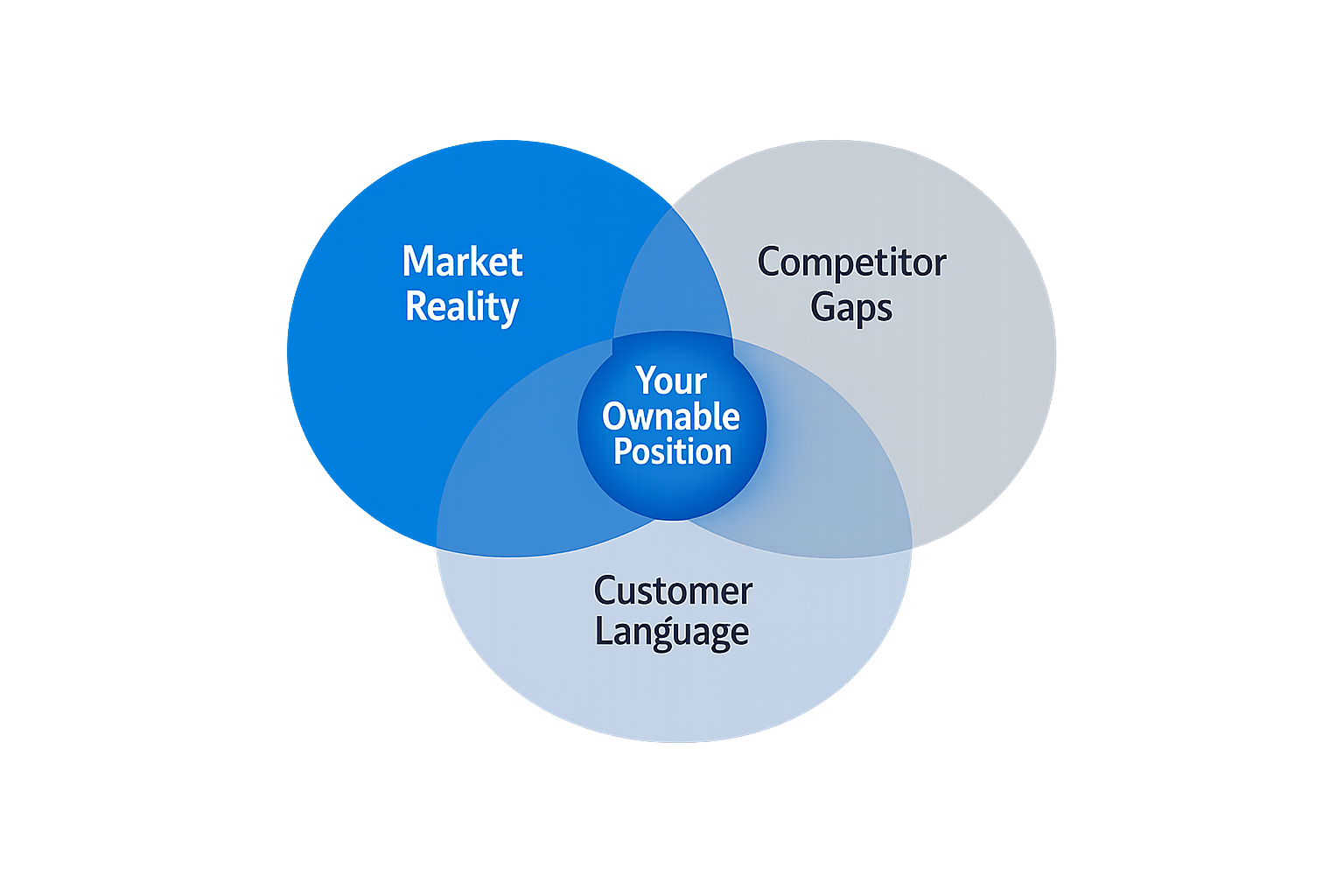
Before you write a single positioning statement, you need honest answers to three questions:
1. What does your best customer say you are?
Not what your product page says. What does the person who gets the most value from your product — the one who would be devastated if you disappeared — actually say when a colleague asks them why they use you?
This is the language your positioning should be built on. Not your internal vocabulary. Not your product team's feature framing. The words your happiest customers use when they're not trying to sound professional.
Go talk to them. Record the calls. Read the transcripts. The positioning is in there.
2. What's the real alternative your buyer is choosing between?
This is rarely your direct category competitor. More often, it's the status quo — Excel, a manual process, nothing, or a homegrown solution. The real alternative shapes the real comparison your positioning needs to win.
If your buyer's true alternative is "doing it manually," your positioning should make the cost of that alternative visceral — not just compare features to Competitor X.
3. What can you credibly own that no one else can?
This requires ruthless honesty. What is your company genuinely better at? Not incrementally better — meaningfully better in a way that matters to your best buyers? And is that thing actually defensible, or can any competitor say the same thing next quarter?
Great positioning lives at the intersection of what you're best at and what your buyers care most about. If those two things don't overlap, you have either a product problem or an ICP problem.
The Anatomy of a Positioning Statement That Actually Works
Here's the structure I use — and it's different from the standard positioning template you'll find in most frameworks:
"For [specific buyer in a specific context], [your brand] is the [category you're competing in] that [unique benefit] because [the reason you can credibly claim it]."
The key words are *specific* and *credibly claim*.
Specificity is what makes it ownable. "For enterprise revenue teams dealing with pipeline visibility gaps" is specific. "For B2B companies" is not.
Credibility is what makes it believable. Your reason-to-believe isn't a feature list. It's the evidence — the customer proof, the methodology, the proprietary data — that proves your claim isn't just marketing copy.
The Signal vs. Noise Test
Once you have positioning candidates, run them through the signal vs. noise test:
The Boring Test: Read the positioning statement aloud. Does it sound like something you've heard before? Could any competitor plausibly claim the same thing? If yes — it's noise.
The Disagreement Test: Does your positioning imply that something is wrong with the way the market currently thinks? Does it take a side? Good positioning is polarizing to some degree. If no one could disagree with it, it's not a position — it's a platitude.
The Memory Test: Show someone outside your company the positioning statement. Wait 48 hours. Ask them to recall it. If they can't — not just the words, but the *idea* — it didn't stick.
The Proof Test: Can you back every claim with evidence? Real data, real customer stories, real results. If not, you don't have a position. You have a hope.
How to Maintain Positioning Discipline When Everything Is Pressuring You to Drift

Positioning erodes in two ways: suddenly (a rebrand gone wrong) and slowly (a thousand small messaging decisions that gradually dilute the core).
The slow erosion is more dangerous because it's invisible until you notice you sound like everyone else again.
Protect your positioning with:
A messaging hierarchy document. One page that defines the core positioning, the proof points, the messaging pillars, and the language guidelines. Every person who writes or speaks on behalf of your brand should have memorized the first section.
A positioning review trigger. Set explicit criteria for when your positioning should be reviewed: new competitive entrants, major market shifts, significant product evolution, or acquisition by a larger entity. Don't review it constantly — drift happens when you revisit positioning on every campaign cycle. But don't ignore it when the market changes materially.
A brand review process. Every major campaign, every major piece of content, every major partnership should be filtered through: *does this reinforce our positioning, or does it muddle it?* Small decisions compound into big drift.
The Counterintuitive Truth About Being Narrow
The fear that drives most brand positioning failures is the fear of being too narrow. "If we position too specifically, we'll exclude buyers."
This fear is almost always backwards.
Narrow positioning creates stronger resonance with the buyers who fit the profile — and those buyers are more likely to convert, stay longer, expand, and refer. Broad positioning creates weak resonance with everyone — and weak resonance doesn't convert.
The brands that win in noisy markets are the ones willing to be the obvious choice for a specific buyer, rather than a plausible option for everyone.
Be the signal. Let the noise belong to your competitors.
The Bottom Line
Great positioning isn't a tagline. It's a strategic decision about who you're for, what you stand for, and what you're willing to stand against. It requires honesty about where you're genuinely differentiated, discipline to maintain it under pressure, and the courage to say something specific enough that some people will disagree.
In a noisy market, clarity is a competitive advantage. Claim yours.