
Speed is a competitive advantage in marketing. Not recklessness — speed. The ability to move from insight to execution faster than your competitors is worth more than most brand strategies, most creative campaigns, and most technology investments.
But most marketing teams aren't slow because their people are slow. They're slow because their infrastructure is slow. Approval chains that take a week. Briefing processes that take three. Tools that don't talk to each other. Data that lives in five different systems and reconciles in none of them.
Building a high-velocity marketing engine means redesigning the infrastructure — the systems, the processes, and the operating norms — so that speed becomes the default, not the exception.
Here's how to do it.
Before you can speed anything up, you have to know what's slow. And in most marketing orgs, the culprit isn't where leaders think it is.
It's usually not the creative work. It's usually not the strategy. The slowness lives in the handoffs: the moment a brief leaves one person's hands and sits in someone else's inbox. The moment a campaign is "ready" but waiting on legal review. The moment a launch is delayed because the data isn't cleaned yet, or the integration isn't set up, or no one assigned the task to anyone.
Do a two-week audit. Track where time goes from brief to live. I'd wager that more than 60% of your total elapsed time is sitting in waiting states — not active work.
That's not a people problem. That's a workflow problem.
The Four Infrastructure Components of a High-Velocity Engine
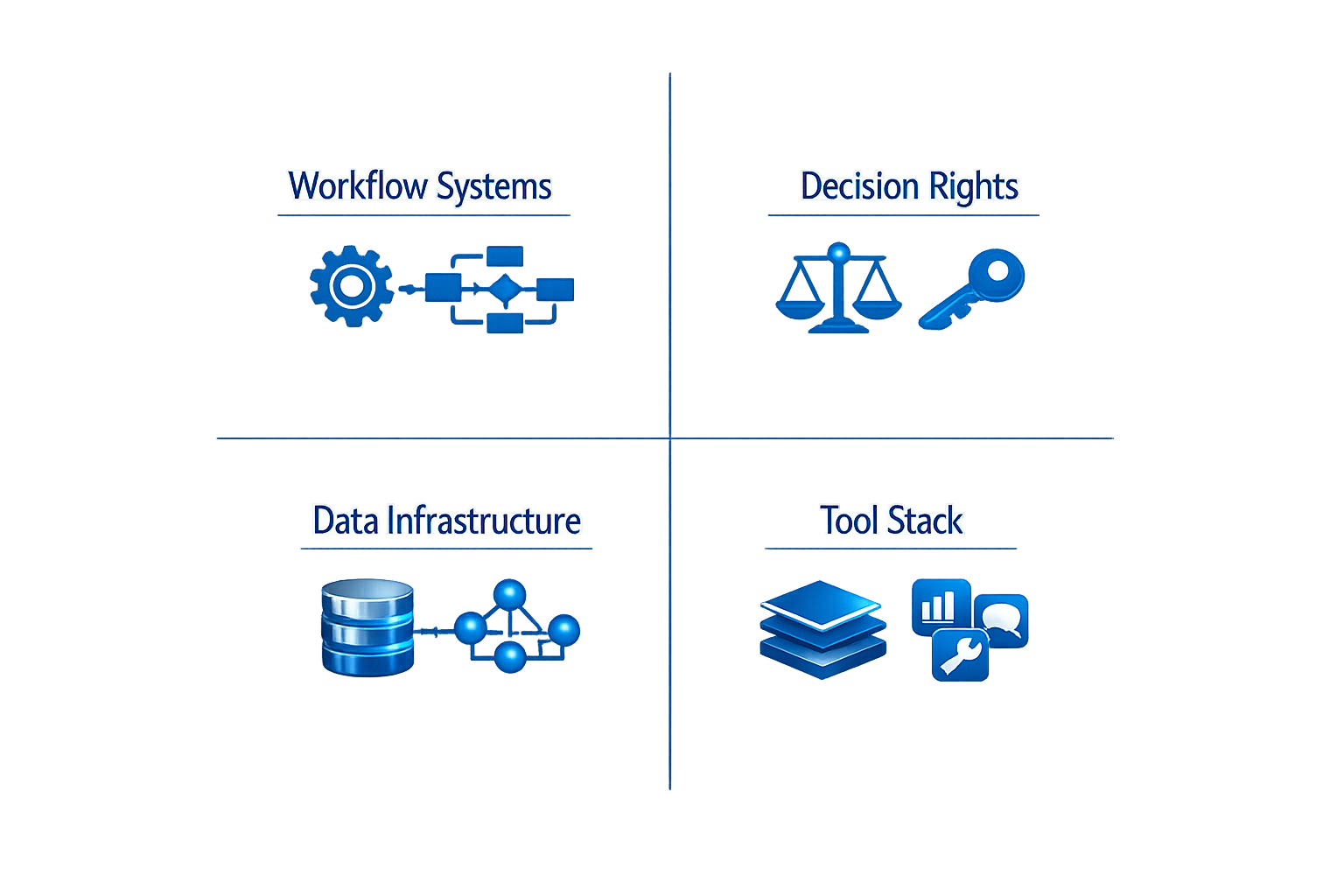
1. Workflow Systems That Eliminate Waiting
The goal of a workflow system isn't to track work. It's to eliminate the conditions that cause work to stall.
High-velocity teams use workflow systems that:
- Auto-assign tasks based on triggers, not manual routing
- Surface blockers before they become delays — not after
- Set SLAs at each handoff stage and alert when they're breached
- Integrate with every tool in the stack so status updates don't require manual entry
Tools like Asana, Linear, and Monday.com can do all of this. Most teams use 20% of their capabilities. The other 80% is where your velocity gains live.
2. Clear Decision Rights
This is the one nobody wants to talk about, but it matters more than the tech stack.
In slow marketing orgs, every decision is a group decision. Every piece of copy needs three rounds of feedback. Every campaign budget needs sign-off from someone who doesn't understand the campaign. Every new channel test requires a committee.
High-velocity teams run on RACI clarity — who is Responsible, who is Accountable, who is Consulted, who is Informed. For every decision type in your marketing org, there should be exactly one Accountable person. Not a committee. One person.
This doesn't mean excluding stakeholders. It means being explicit about whose call it is, so decisions move in hours instead of weeks.
3. Data Infrastructure That's Always Ready
Nothing stops a campaign faster than "we need to pull that data" or "the list isn't ready yet" or "I need to reconcile these numbers first."
A high-velocity marketing engine has data that's always queryable, always fresh, and always trustworthy. That means:
- A single source of truth for contact data — no more "which Salesforce is the real one?"
- Pre-built audience segments that refresh automatically based on current criteria
- Campaign performance dashboards that update in real time, not weekly
- Clean, deduplicated databases that don't require human intervention before every send
Data readiness isn't a project. It's an ongoing operational discipline. Assign it to someone who owns it permanently.
4. A Tool Stack That Accelerates Rather Than Adds Friction
Every tool in your stack should make your team faster. If it doesn't — if it requires more manual work than it saves, if it doesn't integrate with the tools around it, if your team consistently works around it — it's a drag on velocity, not an accelerant.
Audit your stack annually with one question: does this tool reduce the time between insight and action? If the answer is no, either fix the integration or cut the tool.
The Operating Norms That Make Speed Possible
Infrastructure alone doesn't create velocity. The norms — how your team works, communicates, and makes decisions day-to-day — either accelerate or undermine the infrastructure.
Async by Default, Sync When Necessary
High-velocity teams minimize synchronous communication for information sharing. Status updates, campaign reviews, data reports — these should be async. Real-time meetings are reserved for decisions that require live debate and immediate alignment.
The simple shift: move status updates from meetings to a shared channel. Move campaign reviews from live walkthroughs to loom videos with async comment threads. You'll reclaim 30-40% of your team's week without losing alignment.
Short Feedback Cycles, Not Long Review Periods
Instead of accumulating feedback over a two-week review period, build short feedback loops. 48-hour review windows. Single-pass feedback (not iterative rounds that compound delay). Clear criteria for what "approved" means before the review starts.
The goal is to make feedback fast without making it shallow. A well-structured 48-hour review beats an unfocused two-week one every time.
A Bias Toward Launching and Learning

The biggest velocity killer in marketing is the pursuit of perfection before launch. The campaigns that go live imperfect and improve based on real data will always outperform the campaigns that launch perfect six months too late.
Build a culture where "good enough to learn from" is a legitimate launch criterion. Set explicit standards for what constitutes an acceptable MVP for each campaign type. Then launch, measure, and iterate — at speed.
Measuring Velocity: The KPIs That Matter
You can't improve what you don't measure. Track these to understand your current velocity baseline:
- Brief-to-live cycle time — how many calendar days from campaign brief to campaign launch?
- Revision cycles per asset — how many rounds of feedback does a typical asset go through?
- Decision latency — how long from a decision request to a decision made?
- Data readiness rate — what percentage of campaigns launch with all required data ready on day one?
Set benchmarks, track trends, and make velocity improvement a quarterly OKR — not a vague aspiration.
The Bottom Line
High-velocity marketing teams don't move fast because they work harder. They move fast because they've removed the friction that slows everything down. Clean workflows. Clear ownership. Ready data. A tool stack that connects. And operating norms that treat speed as a discipline, not a personality trait.
Build the infrastructure. Set the norms. Measure the outcomes. Speed is a choice — make it a structural one.