The best campaigns aren't just well-designed. They're psychologically engineered.
Not in a manipulative, dark-pattern way — but in the sense that the people who build them understand *why* humans pay attention, *why* they trust, *why* they act, and *why* they hesitate. They use that understanding to create campaigns that resonate at a level that bypasses the buyer's skepticism and lands somewhere more genuine.
Understanding buyer psychology isn't a nice-to-have for marketers. It's the difference between campaigns that get skimmed and campaigns that get acted on.
Here's what the research says — and how to apply it.
Why Emotion Beats Logic (Even in B2B)
Let's dispel the myth right away: B2B buyers are not purely rational. They are humans who make decisions in professional contexts — and those decisions are deeply influenced by emotion, even when the buyer believes they're being analytical.
Research by neuroscientist Antonio Damasio found that patients with damage to the emotional centers of the brain — while retaining full cognitive function — became nearly incapable of making decisions. Emotion isn't the enemy of good judgment. It's a prerequisite for it.
In a B2B marketing context, this means:
- A buyer who *feels* your product will reduce their stress will engage more than a buyer who *understands* it will reduce their workload
- A buyer who *trusts* your brand will advance through pipeline faster than a buyer who just *believes* your claims are accurate
- A buyer who *fears* the cost of inaction will respond to urgency more authentically than one who just *knows* the ROI math
Your campaigns need an emotional through-line — not manufactured drama, but a genuine understanding of the emotional stakes your buyer is navigating.
The Six Psychological Principles That Drive Campaign Performance
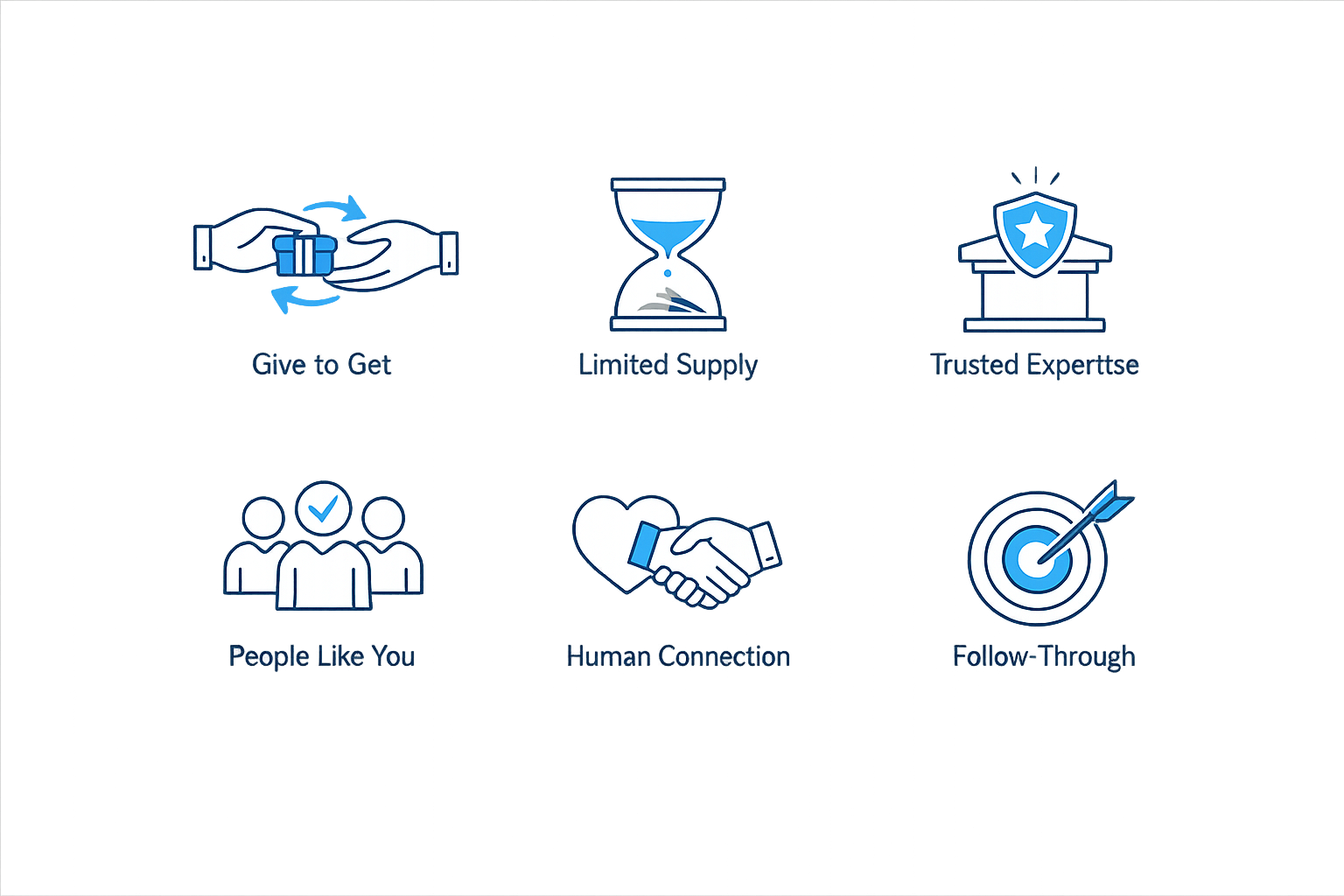
Robert Cialdini's principles of influence have held up for decades because they map to fundamental human wiring. Here's how they apply in modern B2B campaigns:
1. Reciprocity
When you give something of genuine value before asking for anything in return, buyers feel a psychological pull toward reciprocating. This is why ungated content, free assessments, and genuine thought leadership create better pipeline than gated PDFs — they trigger reciprocity without the transactional friction.
In practice: Lead with value. Give away your best insights. The ask should always follow the gift, never precede it.
2. Social Proof
Humans look to others to determine correct behavior — especially in uncertain or high-stakes situations. In B2B, this manifests as: *if companies like mine trust this, it's probably safe for me to trust it too.*
In practice: Case studies from recognizable companies in the buyer's specific vertical outperform generic testimonials by a significant margin. The more the proof looks like the buyer's situation, the more powerful it is.
3. Authority
Buyers defer to expertise — but they have a highly calibrated detector for manufactured authority. A company calling itself "the leader in X" doesn't create authority. A company whose executives speak at industry conferences, publish data-backed research, and are quoted in category media does.
In practice: Build authority through third-party validation — analyst recognition, press coverage, peer community credibility. Authority is conferred, not claimed.
4. Scarcity and Urgency
When something is scarce or time-limited, its perceived value increases. In B2B, manufactured urgency (fake "limited spots" or arbitrary deadlines) backfires because buyers are sophisticated enough to see through it. But genuine scarcity — early access programs, cohort-based onboarding, genuine launch windows — works.
In practice: Only use scarcity and urgency when it's real. Then make the stakes tangible and specific. "Only 5 onboarding slots in Q3" is more credible — and more compelling — than "Limited time offer."
5. Liking
People buy from people (and brands) they like. This sounds obvious, but most B2B marketing is so determined to be "professional" that it strips out all personality, humor, and humanity — and becomes impossible to like.
In practice: Let your brand have a point of view. Let your people be visible. Show the humans behind the product. Warmth and competence aren't in conflict — but most B2B brands prioritize one and forget the other.
6. Commitment and Consistency
Once someone takes a small step toward you — subscribes to a newsletter, downloads a resource, attends a webinar — they're psychologically more likely to take a larger step. Small commitments create pathways to bigger ones.
In practice: Map your campaign touchpoints as a commitment ladder. Each ask should be slightly bigger than the last, and each step should feel like a natural extension of the one before.
The Role of Narrative: Why Stories Outperform Statistics
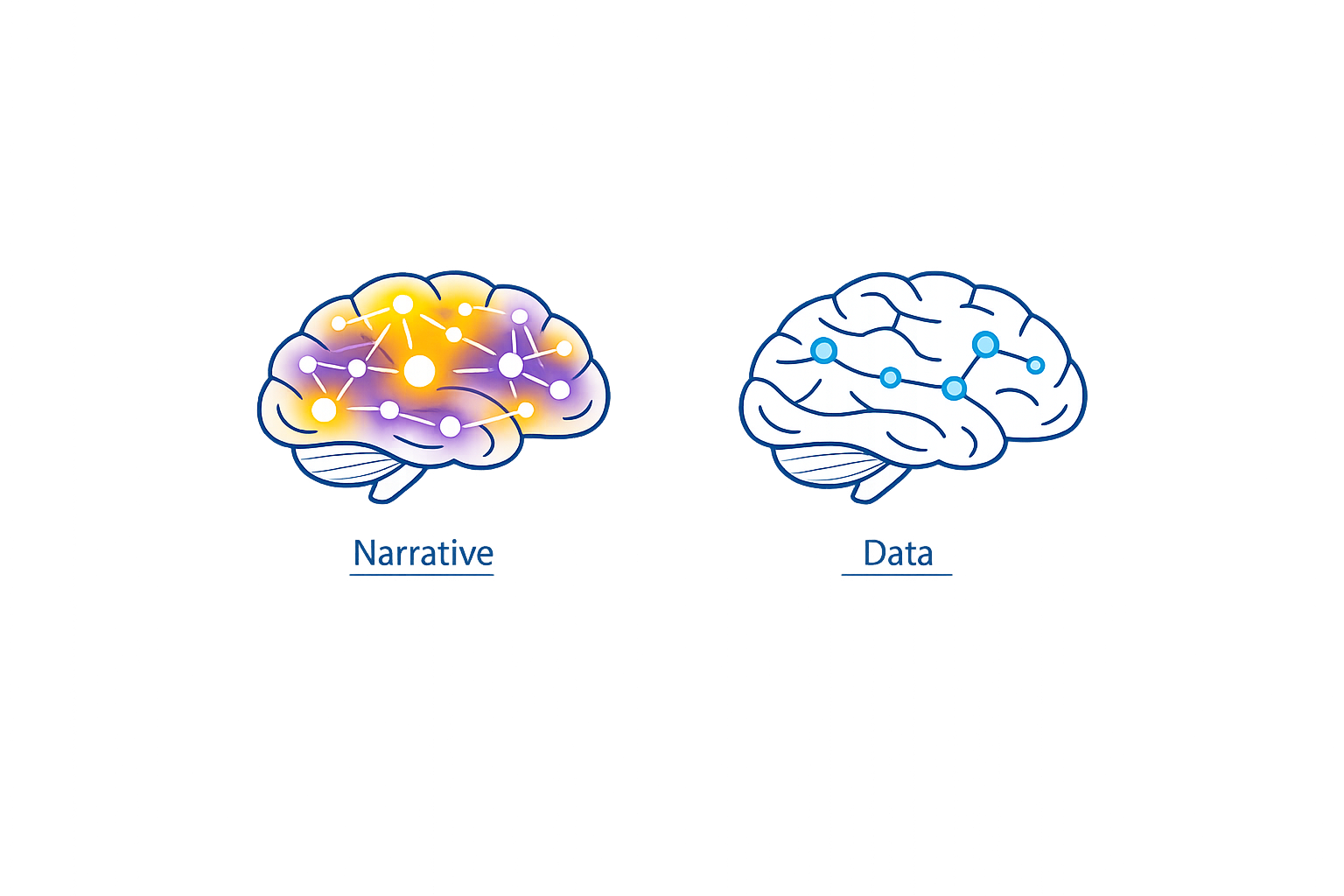
When you present data to a buyer, two areas of the brain activate: language processing and meaning interpretation. When you tell a story, the brain activates the same regions it would if the buyer were *experiencing* the events themselves — sensory cortex, motor cortex, emotional processing centers.
Stories create more than comprehension. They create experience.
This is why the customer story — told well, with conflict and resolution, with a hero who looks like the buyer — outperforms any feature matrix or ROI calculator. The buyer doesn't just understand the value. They feel it.
Structure your customer stories as:
- The world before — what the customer's situation looked like, including the pain
- The moment of decision — why they chose to change, and why they chose you
- The transformation — specific, quantified outcomes that map to outcomes the buyer cares about
- The world after — what it feels like to be on the other side of the problem
That last piece is underrated. Buyers don't buy products. They buy a version of their future. Show them that version in vivid, specific terms.
Timing as a Psychological Variable
Psychological research on decision-making consistently shows that *when* you present a message matters as much as *what* you say.
Key timing principles for campaigns:
The Peak-End Rule: Buyers remember experiences based on how they felt at their most intense moment and at the end — not the average across the experience. Design your campaign sequence so that the most valuable, emotionally resonant content comes at key peaks, and the final touchpoint is exceptional.
Recency Bias: The most recent thing a buyer saw shapes their current perception more than earlier touchpoints. Make sure the last thing they experience before a decision point is your strongest proof — not a generic "just checking in" email.
Cognitive Fatigue: Buyers who have to make many decisions in a short window develop decision fatigue. The implication: make your calls to action simple, singular, and easy to execute. One ask per touchpoint. One clear next step.
The Attention Economy Reality
Your buyer's attention is the scarcest resource in your campaign. They have more messages competing for it than ever before — and their threshold for what earns sustained attention is higher than it's ever been.
The psychological implication: you have approximately 3-5 seconds to earn the right to the next 30 seconds of someone's attention. That first moment — the subject line, the headline, the hook — is a psychological gateway. It doesn't just determine whether they read. It primes how they read everything that follows.
Invest disproportionately in your hooks. The best copy in the world is worthless if nobody reads past the headline.
The Bottom Line
Great campaigns are built on human understanding, not just channel expertise. When you understand why buyers pay attention, why they trust, why they act, and why they hesitate — you can design campaigns that work with human psychology rather than against it.
Study behavioral science. Apply it intentionally. And remember: the most effective psychological principle of all is genuine value. Give people something worth their attention, and the rest becomes much easier.