
Every CMO today claims to be data-driven. But there's a vast difference between a marketing leader who uses data to confirm decisions already made intuitively — and one who has built the infrastructure, the discipline, and the intellectual honesty to let data genuinely inform strategy.
The first is storytelling. The second is leadership.
This guide is for CMOs and marketing leaders who want to close that gap — who want to build organizations where data isn't a reporting exercise but an actual input into how campaigns are built, how budgets are allocated, and how bets are placed.
Here's what that actually looks like.
The Data Maturity Problem Nobody Talks About
Most marketing organizations have a data maturity problem that they mistake for a reporting problem. They invest in dashboards, visualization tools, and BI platforms — and then wonder why decisions don't get better.
The reason: dashboards are the output of data maturity. They're not the source of it. You can build the most beautiful Tableau dashboard in the world on top of a data environment that's inconsistent, incomplete, and untrustworthy — and all you've done is make bad data look polished.
Real data maturity is about the upstream: data quality, data governance, data definitions, and data trust. Before you invest in better reporting, invest in making your data actually reliable.
The test: can every person on your marketing leadership team, independently, pull the same number for the same metric and get the same answer? If not, you don't have a reporting problem. You have a data foundation problem.
The Five Metrics That Actually Matter for Marketing Leaders

There are hundreds of metrics available to a modern marketing leader. Most of them are interesting. These five are the ones that determine your budget, your seat at the table, and your ability to have a strategic conversation with your CFO and CEO.
1. Pipeline Contribution (Not Just Pipeline Generated)
The old metric is pipeline generated by marketing — the raw value of opportunities marketing sourced. The better metric is pipeline contribution: how much of the total pipeline does marketing influence, including both sourced and influenced deals?
This captures the full picture of what marketing does. In most B2B companies, marketing touches far more deals than it creates unilaterally. If you're only reporting sourced pipeline, you're underreporting your impact significantly.
2. Customer Acquisition Cost (CAC) by Channel and Segment
Not just total CAC — CAC broken down by the channel that sourced the opportunity and the segment of the buyer. This is the metric that tells you where to invest more and where to stop.
Most marketing leaders know their blended CAC. Fewer know which channels are acquiring customers at 2x the cost of their best channel — and are still investing in them.
3. CAC Payback Period
How long does it take for the revenue generated by a new customer to recover the cost of acquiring them? This is the metric that connects marketing investment to cash flow — and it's the one your CFO is thinking about when they push back on your budget.
If you can show a shorter payback period from marketing-generated pipeline vs. other sources, you have a compelling argument for increasing marketing investment.
4. Marketing-Sourced Revenue (Closed-Won)
Pipeline is a leading indicator. Revenue is the outcome. Tracking the revenue actually closed from marketing-sourced opportunities — not just the pipeline created — connects your team's work to the number that matters most in the board meeting.
5. NRR (Net Revenue Retention) Influence
This one is often neglected by CMOs who think their job ends at customer acquisition. But marketing plays a significant role in customer expansion and retention — through education, community, events, and lifecycle campaigns.
Understanding marketing's influence on NRR positions you not just as a pipeline driver but as a revenue steward across the full customer lifecycle.
Building Decision Frameworks That Use Data Without Being Enslaved by It
The great CMOs I've observed don't choose between data and instinct. They use data to calibrate instinct — to check whether their intuitions are being confirmed or contradicted by actual performance, and to decide when to override a data signal based on market knowledge that isn't yet reflected in the numbers.
The 70/30 Framework:
70% of your decisions should be data-validated — meaning the data either points clearly in a direction, or it's strong enough to rule out the bad options. 30% of your decisions will involve genuine uncertainty — insufficient data, new market territory, or a strategic bet that requires conviction in the absence of proof.
The mistake is treating everything as if it belongs in one bucket. Some decisions should be pure data calls. Others require a human judgment that the data cannot fully inform.
Knowing the difference is a leadership skill.
The Attribution Trap: Why Most Attribution Models Lie (a Little)
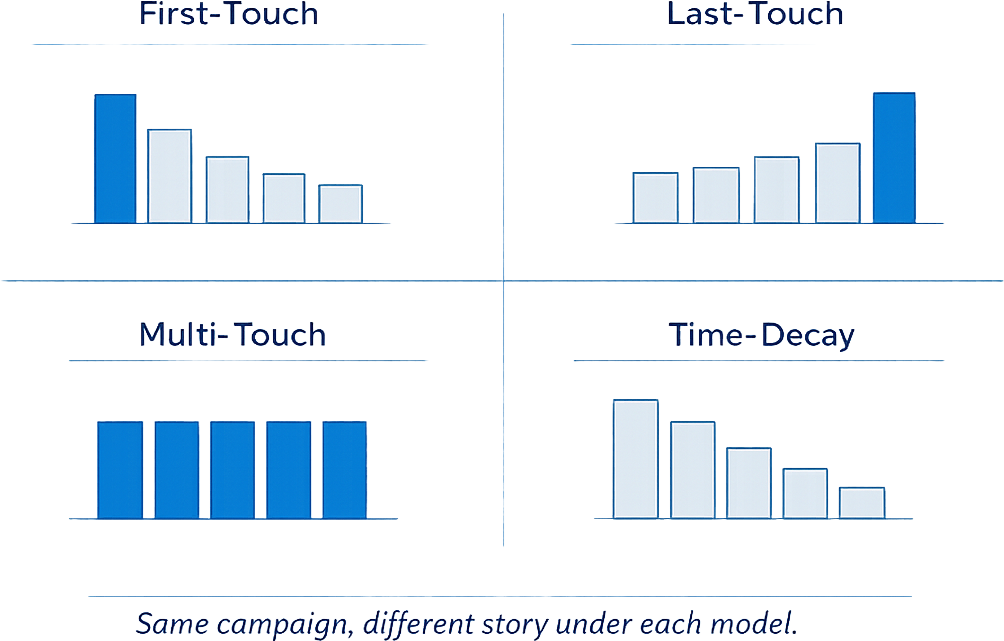
Attribution is the most politically charged topic in marketing analytics — because it determines who gets credit, and credit determines budgets.
Here's the honest truth about attribution: every model is wrong in some way. First-touch attribution overcredits the top of funnel. Last-touch overcredits the bottom. Multi-touch models distribute credit but struggle to weight channels accurately. Time-decay models are better but still imprecise.
The goal isn't to find the perfect attribution model. The goal is to use a consistent model that everyone in the organization agrees to, and to triangulate it with complementary approaches — media mix modeling, incrementality testing, pipeline velocity analysis — to build a more complete picture.
The CMO who insists their attribution model is accurate is either naive or not looking hard enough. The CMO who says "here's what our primary model shows, here's what our secondary analysis suggests, here's our confidence level" — that's the one having the right conversation.
Building a Culture of Data Discipline in Your Marketing Org
Data-driven decision making isn't just a leadership behavior. It's a cultural practice that has to be embedded across the team.
Build it through:
Structured campaign reviews with mandatory data pull. Every campaign post-mortem should begin with the data — not a narrative about what went well, but the numbers. What were the targets? What were the actuals? Where did we overperform and where did we underperform?
Hypothesis-driven planning. Every major campaign investment should begin with a hypothesis: "We believe that doing X will result in Y, as measured by Z." This creates accountability and makes it possible to learn from outcomes — whether positive or negative.
Failure reports, not just success stories. The teams that learn fastest are the ones that study failure as rigorously as they celebrate success. Build a culture where reporting what didn't work — and what you learned from it — is rewarded rather than hidden.
Data literacy investment. Not every marketer needs to be a data scientist. But every marketer should be able to read a dashboard, interpret basic statistics, and ask good questions of data. Invest in training. Make data literacy a promotion criterion.
The CMO's Role in Revenue Architecture
The most effective CMOs don't just measure revenue impact — they architect it. They're involved in the design of the sales process, the customer success model, and the product growth strategy, because all of these affect marketing's ability to generate and retain revenue.
This requires moving beyond the role of "head of demand gen and brand" into the role of chief growth architect — someone who understands the full revenue system and uses data to identify the constraints on growth, wherever they live.
If the constraint is pipeline volume, the answer is more marketing. If the constraint is conversion rates, the answer is better sales enablement. If the constraint is retention, the answer might be product or customer success. The data tells you where to look. The CMO decides where to lead.
The Bottom Line
Data-driven marketing leadership isn't about having the best dashboards. It's about building an organization that trusts its data, makes decisions based on evidence rather than politics, and learns faster than the competition because it's honest about what the numbers say.
Build the data foundation first. Establish the metrics that matter. Create the decision frameworks. And then use your data not as a substitute for judgment — but as the sharpest tool in your judgment kit.