
For twenty years, ranking well on Google was the finish line for organic marketing. That finish line has moved. A growing share of B2B buyers now ask ChatGPT, Claude, Perplexity, or Gemini a question before they ever type it into a search bar, and those tools don't crawl and rank pages the way Google does. They synthesize an answer, often citing only a handful of sources. If your content isn't structured to be one of those sources, you're invisible in a channel that's only getting bigger.
AEO and GEO, defined simply
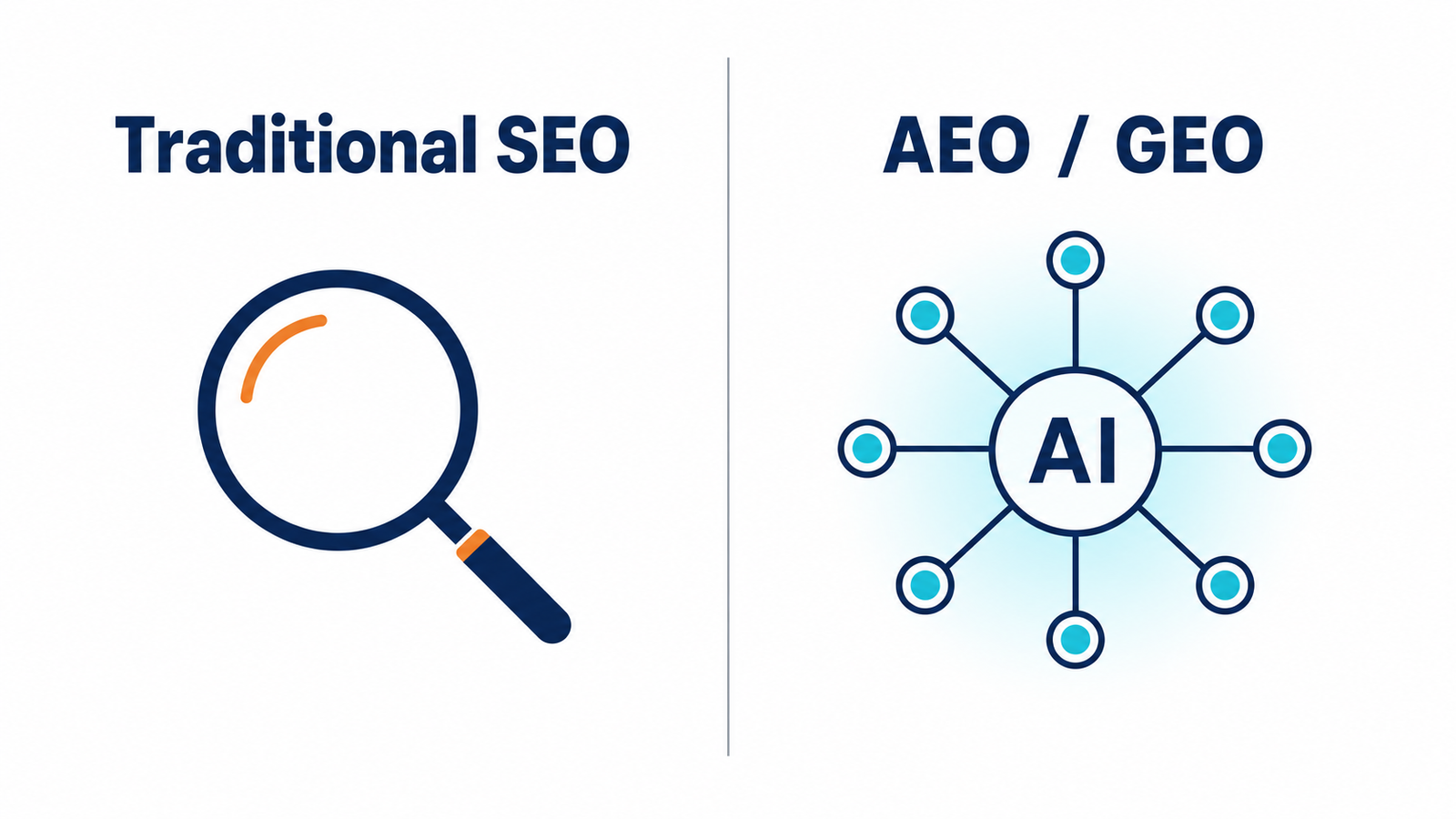
Answer Engine Optimization, AEO, is about structuring content so it can be extracted as a direct answer, the way a featured snippet works, but for AI assistants instead of a search results page. Generative Engine Optimization, GEO, is the broader discipline of making your brand more likely to be cited, recommended, or summarized accurately when someone asks an AI model a question your company could answer.
They overlap heavily with SEO, but they reward different things. Google SEO rewards backlinks, keyword density, and site authority signals. AI models reward clarity, direct answers, structured data, and content that's easy to extract cleanly without ambiguity.
What actually changes on the page
- Lead with the direct answer, then explain, instead of building up to the point
- Use clear headers that match the actual questions a buyer would ask
- Add structured data and schema markup so AI crawlers can parse your content accurately
- Keep factual claims specific and sourced, since AI models weigh precision heavily
- Make sure your brand's positioning statement is unambiguous, since AI models often summarize it verbatim
I ran this audit on my own company's site
I recently audited our own website for AI visibility rather than just traditional SEO, scoring it against the same criteria I'd apply for a client. The site was strong on traditional SEO fundamentals and noticeably weaker on AEO readiness: too much content buried the answer under three paragraphs of setup, and key differentiators weren't stated plainly enough for an AI model to summarize accurately. That gap is common. Most companies have spent a decade optimizing for Google's algorithm and none optimizing for how a language model reads a page.
This isn't a replacement for SEO. It's an addition.
I want to be clear about one thing: traditional SEO still matters enormously. Most AI search tools still lean on the same underlying web index that powers traditional search. AEO and GEO are additive disciplines, not replacements, and the companies getting ahead right now are the ones treating both as part of the same content strategy instead of choosing one over the other.
Where to start
Pick your five highest-intent pages, the ones a buyer would land on right before a purchase decision, and rewrite the opening of each one to answer the core question in the first two sentences. Add schema markup. Then ask an AI assistant your own core positioning question and see if it gets your company right. If it doesn't, you've just found your next content priority.