
Account-based marketing has been one of the most hyped — and most misunderstood — strategies in B2B for the past decade.
Vendors sold it as a technology purchase. Consultants sold it as a methodology overhaul. And many marketing teams bought it, implemented it, ran it for two quarters, couldn't prove ROI, and quietly shelved it.
Meanwhile, the small percentage of teams that got ABM right are generating outsized pipeline, closing bigger deals, and building sales-marketing alignment that actually holds.
The difference isn't the technology. It's the clarity about what ABM actually is, what it requires, and what it can and cannot do.
Let me give you the unvarnished version.
What ABM Actually Is (Not the Vendor Version)
ABM is not a product. It's not a campaign type. It's not "personalized ads at scale" or "reverse IP lookup with a nice dashboard."
ABM is a strategic operating model in which marketing and sales identify a specific set of high-value target accounts, coordinate resources and activities around those accounts, and pursue them with a level of focus and personalization that would be impossible if spread across the entire addressable market.
The core insight — and it's deceptively simple — is that **not all accounts are equal**, and the best returns come from concentrating your best resources on your best opportunities.
Everything else follows from that.
The Three Models of ABM (and Which One You Actually Need)
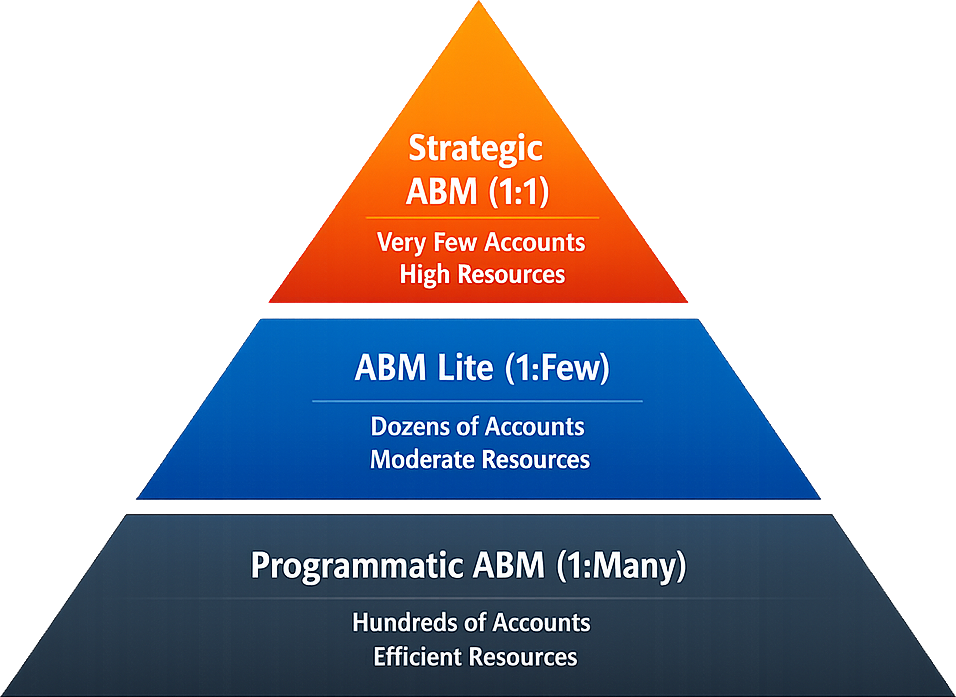
Strategic ABM (1:1)
Hyper-personalized programs for your most valuable target accounts. We're talking custom content, bespoke events, tailored outreach for each account. This is expensive, slow, and appropriate for accounts with enough potential revenue to justify the investment. Most companies have 5-20 of these.
ABM Lite (1:Few)
Personalized programs for clusters of accounts with shared characteristics — same industry, same pain point, same buying committee profile. You're not building custom assets for each account, but you're building them for each cluster. This is where most companies should be spending most of their ABM energy. Typically 50-200 accounts.
Programmatic ABM (1:Many)
Technology-enabled personalization at scale for a broader tier of target accounts. This is where intent data, dynamic ad personalization, and automated sequence triggers do the heavy lifting. Effective when accounts are selected carefully and the personalization is genuine rather than token. Can cover hundreds to thousands of accounts.
Most companies try to run programmatic ABM across their entire ICP and call it ABM. It's not. It's just targeted demand gen with a different label. Choose your model deliberately based on account value and resource availability.
The Prerequisites Most Teams Skip
Here's why most ABM programs fail, stated plainly:
They start with the technology before they've done the strategy.
You don't need an ABM platform to run ABM. You need an ideal account profile, a target account list, and aligned sales and marketing teams. The technology amplifies what's already there — it doesn't create it.
Before you spend a dollar on ABM software, answer these questions:
- What does your ideal account profile actually look like?
Not just firmographics — industry, headcount, revenue. Behavioral and situational characteristics. What does the account look like *right before* they typically buy? What signals indicate they're in-market? What triggers make them move? - Is your sales team willing to co-own the target account list?
ABM fails when marketing builds a list and sales ignores it. The target account list must be a joint exercise — sales reps identifying strategic accounts, marketing validating against ideal account criteria, leadership approving the final set. If your AEs aren't invested in the list, the program is dead before it starts. - Do you have the content to support personalized engagement?
ABM without personalized content is just targeted advertising. You need industry-specific case studies, persona-relevant messaging, and custom touchpoints that demonstrate you've done your homework on each account. If your content library is generic, build it before you launch the program.
Building the ABM Playbook: What to Do, In Order

Step 1: Define and validate your ICP at the account level.
Use your closed-won data. What do your best customers have in common — not just on paper, but in terms of situation, timing, and buying trigger? Build your ICP from closed-won patterns, not from assumptions.
Step 2: Build your Tier 1 and Tier 2 account lists.
Tier 1: strategic accounts where you run deep 1:1 programs. Tier 2: cluster accounts where you run 1:Few programs. Keep the lists tight. ABM with 500 Tier 1 accounts isn't ABM.
Step 3: Gather account-level intelligence.
For Tier 1 accounts, this means genuine research: who are the key stakeholders, what initiatives are they running, what's their business context, what pain are they likely experiencing? This intelligence shapes every outreach and every asset.
Step 4: Map content to account stage and persona.
Every target account has multiple stakeholders with different concerns. Your content map should address: the economic buyer's ROI concerns, the practitioner's workflow concerns, and the IT or procurement stakeholder's risk concerns. One piece of content cannot serve all three.
Step 5: Coordinate marketing and sales motions.
Define who does what, and when. Marketing runs awareness and engagement plays. Sales runs personalized outreach. Both are looking at the same account signals and sharing intelligence in a shared view (most commonly Salesforce). The handoff criteria are explicit: what signal triggers a sales outreach? What signal triggers a marketing play?
Step 6: Measure at the account level.
This is where most ABM reporting falls apart. You cannot measure ABM with lead-level metrics. Measure account-level engagement (are the right people at the account engaging?), pipeline influence (did your ABM activities accelerate or create pipeline at target accounts?), and deal outcomes (win rate, deal size, sales cycle velocity for target accounts vs. non-target accounts).
The Sales-Marketing Alignment Reality Check
ABM is the highest-leverage activity for genuine sales-marketing alignment — and it's also where alignment failures become most visible, most fast.
The teams that make ABM work have:
- Joint account list ownership with quarterly review cadence
- Shared account intelligence in a system both teams actually use
- Explicit agreement on what "engaged" looks like at an account and what triggers a sales action
- A feedback loop where sales reports back on account conversations and marketing adjusts accordingly
The teams that don't:
- Marketing builds programs. Sales ignores them.
- Sales does outreach. Marketing doesn't know what they said.
- Neither team can answer: what is the combined experience this account is having with us right now?
If you can't answer that last question, you're not running ABM. You're running parallel programs that happen to share a target list.
The Bottom Line
ABM done right is one of the most powerful revenue-generating strategies available to a B2B company. Done wrong — bought as a technology, launched without alignment, measured with the wrong metrics — it's an expensive distraction.
Strip the buzzwords. Get clear on the model, the prerequisites, and the playbook. Then run it with discipline.
The accounts that matter most deserve more than a generic campaign. Give them something worth their attention, and they'll give you something worth your time.