What to build first, what to measure, and what to ignore. Written from twenty years of running digital marketing for B2B companies, including a 730% increase in website traffic at Simio.
Most B2B digital marketing fails for a boring reason: the pieces are built in the wrong order. Companies buy ads before the website explains what they do, publish content before anyone can measure it, and add tools before they have a process. The channels are fine. The sequence is the problem.
The four layers of a digital-first B2B strategy
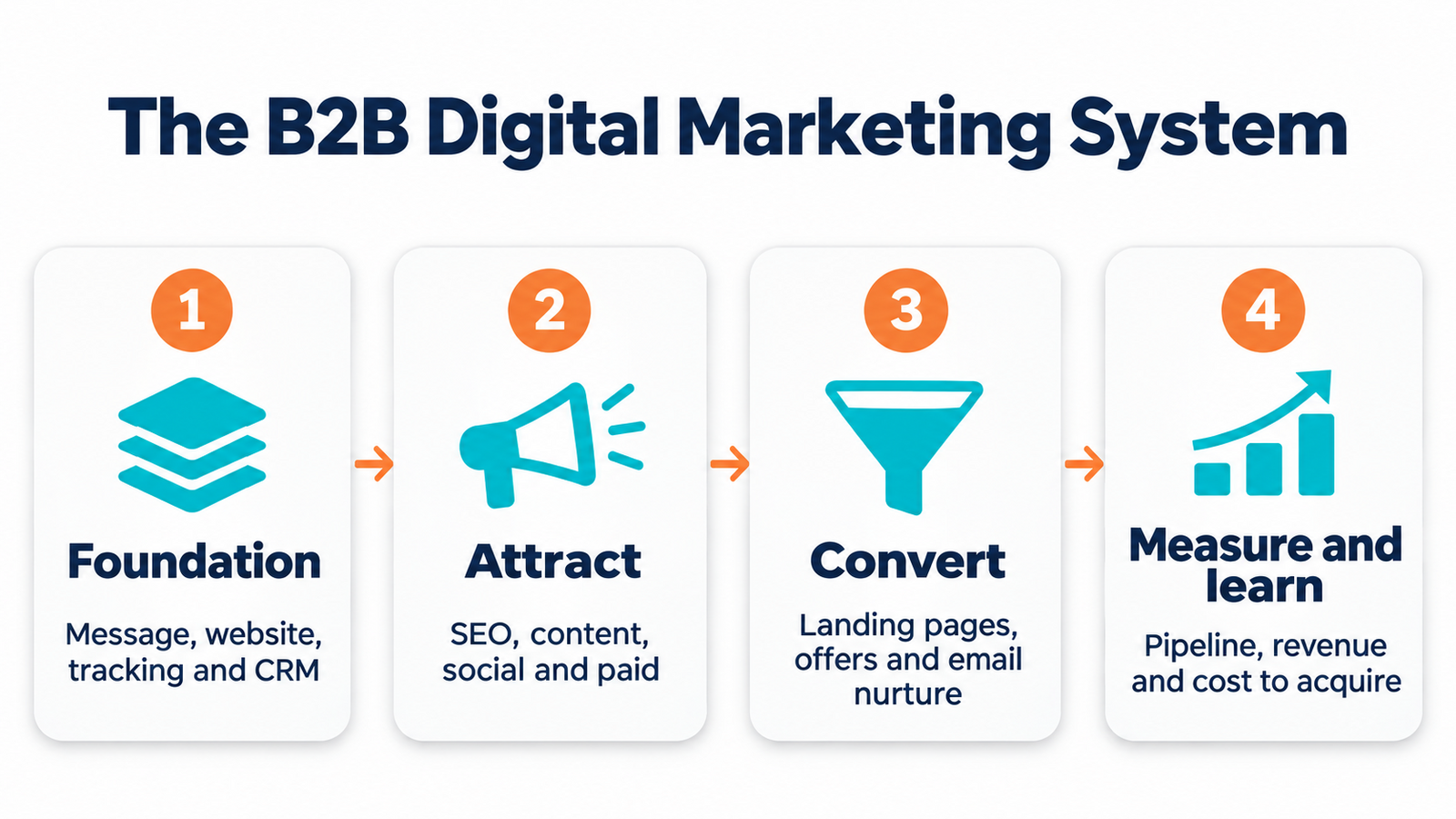
Build in this order: foundation, attract, convert, then measure and learn.
1. Foundation
A clear message, a fast website, accurate analytics and a CRM that sales actually uses. If a visitor cannot tell within a few seconds what you do and who it is for, nothing downstream works.
2. Attract
This is search, content, social, paid media and partnerships. For most B2B companies, organic search and helpful content carry the most weight over time, and paid media fills gaps while that builds. Today that includes being found in AI answers too. See AI, AEO and GEO.
3. Convert
Landing pages, offers, forms, email nurturing and marketing automation that turn interest into conversations. A small number of strong offers beats a large number of weak ones.
4. Measure and learn
Report on pipeline and revenue, not activity. A scorecard your CEO will actually read beats a dashboard nobody opens.
A sensible 90-day sequence
Weeks 1 to 2: audit message, site, tracking and CRM hygiene.
Weeks 3 to 6: fix the technical SEO basics, tighten the top pages, set up lead capture and routing.
Weeks 7 to 10: publish content around the questions buyers already ask, and start a simple nurture.
Weeks 11 to 13: review what moved pipeline, cut what did not, and set the next quarter.
Common mistakes
Measuring traffic instead of pipeline.
Adding tools before the process is defined.
Treating SEO as a one-time project rather than an ongoing program.
Letting marketing and sales use different definitions of a good lead.
B2B digital marketing is the use of your website, search, content, email, social, paid media and marketing technology to attract, qualify and convert business buyers, and to prove the impact on pipeline and revenue.
Where should a B2B company start with digital marketing?
Start with the foundation: a clear message, a fast site that explains what you do, accurate tracking, and a way to capture and follow up on leads. Channels such as SEO, paid and email work much better once those are in place.
How long does B2B SEO take?
It varies by competition and starting point, but plan in quarters rather than weeks. Early gains usually come from fixing technical issues and improving pages that already have impressions.
What metrics matter most?
Pipeline and revenue influenced, cost to acquire a customer, conversion rate from lead to opportunity, and the quality of leads, not raw traffic or follower counts.
Want the AI side of this?
AI Prompts for Marketing covers prompts for social, email, ads, SEO, copy and more.